
AFPM Core OEM Sourcing & Supplier RFQ
Screen AFPM core OEM sourcing paths and prepare a copyable RFQ checklist. Compare material, tooling and delivery scope; confirm prices, schedules and approval requirements with the supplier.
Request engineering reviewScreen a sourcing path & prepare your OEM RFQ
Choose geometry, material and scope for a sourcing checklist. Tooling estimates are subject to part CAD review; prices and schedules remain unknown until quoted.
Unknown — request dated tooling, sampling and approval milestones
Trial a dedicated compaction die and qualify density, ejection and heat-treatment controls before scaling.
Unknown — define parts per motor set and delivery scope
Tooling NRE: Unknown — supplier CAD/DFM quotation required
Customer PPAP level to confirm
Agree applicable records, test methods, sampling and acceptance criteria with the customer. This checklist does not establish certification or part approval.
Geometry candidate
Yokeless segmented teeth
Process discussion
Pilot validation: smc
Scope and evidence
insulated subassembly · automotive planning
1,200 motor sets/year · pilot phase · smc. Material suitability, capacity and customer release remain to confirm.
Primary Quality & Compliance Deliverables
- Verify IATF 16949 certificate scope and customer-specific requirements; agree the PPAP submission level (Level 3 is a planning example).
- Agree PFMEA, control plan, MSA and initial capability criteria with customer quality; thresholds are not calculated here.
- Document lot traceability, material declarations where required and customer release status.
Technical Risks & Audit Focus
- Risk: Density gradients and ejection cracks at section transitions
- Risk: Machining and heat treatment can change particle insulation and core loss
- Risk: Validate tooth retention from hot/aged assembly loads, asymmetric gaps and fault cases; no universal per-tooth force applies.
- Audit: Powder grade, storage requirements and lot traceability
- Audit: Press force, fill/ejection control and grade-specific heat-treatment records
View or manually copy the complete RFQ data package brief
By AxialFluxCore · First recorded · Evidence reviewed .
Annual editorial review, with earlier revisions when material or standards evidence changes. Public source scopes were checked on the review date. Licensed clauses, project compliance, supplier capacity and commercial offers have not been independently audited.
Evidence policy: references support only their stated method or scope. Procurement worksheets, process paths and scenarios are editorial guidance. No supplier pricing dataset is used; lead times, costs and acceptance values remain unknown until agreed for your project.
Five Strategic Decisions Before Issuing an AFPM Core RFQ
Define one comparable motor set
List each part and quantity, drawing revision and delivery scope before comparing offers. The tool brief records open items for supplier review.
Basis: editorial procurement guidance. Validate against the project specification; no universal acceptance limit or commercial dataset.
Keep grade and processing evidence together
Manufacturer guidance for Somaloy 5P is grade-family specific. Require supplier evidence for the actual material and finished-part route.
Scope references (editorial actions require project validation): Höganäs Somaloy 5P — manufacturer process guidance · Höganäs — effect of manufacturing processes on coated SMC
Choose the magnetic method by material
IEC 60404-6 excludes electrical steels. Use an appropriate steel method and correlate specimen data to delivered components.
Scope references (editorial actions require project validation): IEC 60404-6:2018 — AC ring measurement methods · IEC 60404-2 — electrical steel sheet/strip measurement
Agree approval evidence with the customer
PPAP submission and customer release require an agreed package. A QMS certificate alone does not approve a component.
Scope references (editorial actions require project validation): AIAG PPAP-4 — Production Part Approval Process · IATF 16949:2016 — official publications and customer requirements
Qualify insulation at system level
Converter-fed Type I winding-system tests depend on the actual electrical stress. Bare-core material selection cannot set a universal PDIV limit.
Scope references (editorial actions require project validation): IEC 60034-18-41:2014+AMD1:2019 — Type I insulation systems
Reproduce the default sourcing screen
Select YASA, SMC, pilot phase, 1,200 motor sets/year, 220 mm OD, automotive quality and insulated subassembly, or use Reset defaults. The candidate path requests compaction-die trials and process validation. Schedule, tooling NRE and unit price remain unknown. This is a reproducible software example, with no supplier or hardware performance claim.
1. Separate a procurement screen from part approval
This tool organizes buyer inputs and supplier questions. It cannot qualify a vendor or determine a commercial price.
Begin with the part boundary: individual tooth, bonded stack, annular core, insulated component or complete wound stator. Define a motor set by listing the quantities and revisions of each part. Without this definition, two quotations labelled “per set” can cover different work.
The model selects a discussion path from the chosen process and development phase. Annual volume and stator-envelope OD are recorded in the brief, not used to calculate press force, cavitation, magnetic loss or price. This distinction lets procurement request comparable evidence without treating missing engineering inputs as measured results.
Basis: editorial procurement guidance. Validate against the project specification; no universal acceptance limit or commercial dataset.
Read left to right; scroll horizontally on narrow screens. This is a procurement workflow, with limits agreed by the responsible engineering team.

Recommended procurement action: Agree the BOM, drawing revision and responsibility split before requesting comparable quotes.
2. Topology is a geometry question, not a material verdict
Stator/rotor count alone does not determine whether back iron, powder compaction or a particular tooling process is required.
Yokeless segmented armatures use separate teeth without a common stator yoke. SSDR describes one stator and two rotors and can include a yokeless design; it does not imply a continuous slotted ring. DSSR describes two stators around one rotor, but the actual return-flux path and mounting layout must still be supplied.
A slotless stator can retain magnetic back iron, while a fully coreless stator has no magnetic stator core. The tool covers the former. For a coreless concept, send the coil, rotor and support requirements for engineering review instead of treating the selected core material as a recommendation.
Basis: editorial procurement guidance. Validate against the project specification; no universal acceptance limit or commercial dataset.
Editorial procurement worksheet. Unknown commercial and acceptance values require supplier evidence and customer agreement.
| Topology | Known from label | Still required |
|---|---|---|
| YASA | Yokeless segmented armature | Retention load path and actual tooth geometry |
| SSDR | One stator, two rotors; may be yokeless | Cross-section and back-iron/flux path |
| DSSR | Two stators, one rotor | Both gaps and mounting/load paths |
| Slotless with back iron | No stator teeth; magnetic backing retained | Backing geometry, strip/grade and coil support |
| Fully coreless | No magnetic stator core | Outside this tool: review coils, rotor and supports |
Basis: editorial procurement guidance. Validate against the project specification; no universal acceptance limit or commercial dataset.
Recommended procurement action: Attach a cross-section showing flux direction, magnetic back iron, gaps and support interfaces.
3. Compare material candidates at matched conditions
A family label is insufficient to rank magnetic loss, permeability, cost or mechanical strength.
Request the exact grade, specimen preparation, frequency, peak flux density, temperature and excitation waveform for each candidate. Separate B at a stated field from saturation polarization: the two are not interchangeable. Ask how supplier curves correlate with the actual machined, pressed or stacked part.
For one concrete process example, Höganäs specifies 600–800 MPa compaction and N2 heat treatment at a maximum 650°C for Somaloy 5P. Its process study shows why processing history matters. These conditions are not a recipe for all powders, and they do not establish a finished-tooth strength guarantee.
Scope references (editorial actions require project validation): Höganäs Somaloy 5P — manufacturer process guidance · Höganäs — effect of manufacturing processes on coated SMC
Read left to right; scroll horizontally on narrow screens. This is a procurement workflow, with limits agreed by the responsible engineering team.

Editorial procurement worksheet. Unknown commercial and acceptance values require supplier evidence and customer agreement.
| Candidate | Process issue | Required comparison evidence |
|---|---|---|
| SMC | Density and particle insulation after processing | Exact grade, B-H/loss curves and finished-part correlation |
| Tape-wound GOES | Rolling direction, cut edges and stress | Grade, orientation, post-cut loss and stack dimensions |
| Segmented NOES | Burrs, stacking and bonding | Sheet thickness/coating, stack factor and finished-stack loss |
| Amorphous ribbon | Brittleness and stress sensitivity | Alloy, handling/annealing route and encapsulated performance |
Scope references (editorial actions require project validation): Höganäs — effect of manufacturing processes on coated SMC
Recommended procurement action: Compare measured grade-specific curves and post-process samples; keep unmeasured values marked unknown.
4. Choose tooling by revision risk and validated economics
A prototype/pilot/series phase is independent of annual volume; there is no universal break-even volume.
Compare a development tool or supplier-qualified blank route with production tooling. Ask whether blank machining is feasible for the actual geometry and coating system, and how it changes loss, strength and surface insulation. A machined prototype is not automatically representative of a later pressed production part.
For a like-for-like quantity basis, break-even quantity equals extra fixed investment divided by the positive per-unit saving. Include maintenance, qualification, yield and revision risk; if the unit saving is zero or negative, the simple model has no positive break-even. Quotes and schedules must come from dated supplier offers.
Basis: editorial procurement guidance. Validate against the project specification; no universal acceptance limit or commercial dataset.
Read left to right; scroll horizontally on narrow screens. This is a procurement workflow, with limits agreed by the responsible engineering team.

Editorial procurement worksheet. Unknown commercial and acceptance values require supplier evidence and customer agreement.
| Phase | Candidate route | Commercial unknown | Release evidence |
|---|---|---|---|
| Prototype | Qualified blank/development tooling | Price and completion date: supplier quote | Geometry and post-process properties demonstrated |
| Pilot | Dedicated tooling trials | NRE, yield and sampling: supplier quote | Repeatable process and correlated inspection |
| Series | Capacity/cavity options | Maintenance, rate and piece price: supplier quote | Customer-approved process and capacity |
Basis: editorial procurement guidance. Validate against the project specification; no universal acceptance limit or commercial dataset.
Recommended procurement action: Request two route-specific offers with identical part scope, lifetime quantity and acceptance requirements.
5. Audit the actual process and its subcontractors
Capability evidence must match the selected material and delivery scope.
For SMC, inspect powder handling, fill/ejection controls and grade-specific thermal processing. For laminated steel, inspect strip traceability, burrs, stacking and bonding. For ribbon, inspect handling, heat treatment and stress control. A powder press is not a prerequisite for a lamination supplier.
Use a competent auditor with the contracted VDA 6.3:2023 edition and current interpretations when required. This playbook does not map powder-specific checks to official starred question numbers or calculate downgrade rules. An audit rating is evidence for a sourcing decision, rather than automatic customer production approval.
Scope references (editorial actions require project validation): VDA 6.3:2023 — official sanctioned interpretations and FAQs
Read left to right; scroll horizontally on narrow screens. This is a procurement workflow, with limits agreed by the responsible engineering team.

Read left to right; scroll horizontally on narrow screens. This is a procurement workflow, with limits agreed by the responsible engineering team.

Editorial procurement worksheet. Unknown commercial and acceptance values require supplier evidence and customer agreement.
| Process concern | Evidence to prepare | Scoring boundary |
|---|---|---|
| Project delivery | Tool and sample milestones with escalation owners | Use contracted manual/edition |
| Development | Validation evidence for actual material/process | Auditor determines applicable questions |
| Production | Traceable material, process and inspection records | No invented powder-specific starred numbering |
| Customer response | Containment and change-control records | Customer conditions govern nomination/release |
Scope references (editorial actions require project validation): VDA 6.3:2023 — official sanctioned interpretations and FAQs
Recommended procurement action: Review process records and qualified external-laboratory arrangements, including outsourced steps.
6. Agree automotive submission and customer release
Quality planning requires customer agreement on the submission package and acceptance criteria.
Confirm certificate validity, site scope and applicable customer-specific requirements independently from the part approval package. Use Level 3 as a discussion example only; the customer determines the required submission level and applicable evidence.
Request a process flow, PFMEA, control plan, measurement-system evidence, dimensional/material results and capability studies as applicable. Define characteristics, sampling, statistical index, study conditions and limits with customer quality. Do not assign a universal Cpk, Ppk, sample size or signatory to every core.
Scope references (editorial actions require project validation): AIAG PPAP-4 — Production Part Approval Process · IATF 16949:2016 — official publications and customer requirements
Read left to right; scroll horizontally on narrow screens. This is a procurement workflow, with limits agreed by the responsible engineering team.

Editorial procurement worksheet. Unknown commercial and acceptance values require supplier evidence and customer agreement.
| Record group | AFPM-specific content | Who confirms acceptance |
|---|---|---|
| Design records | Controlled CAD, BOM, datums and magnetic targets | Customer design authority |
| Process flow / PFMEA / control plan | Material-specific operations, failure modes and controls | Customer and supplier quality |
| MSA and capability | Agreed characteristics, study conditions and indices | Customer quality |
| Results and release | Dimensional/material results and submission disposition | Authorized customer representative |
Scope references (editorial actions require project validation): AIAG PPAP-4 — Production Part Approval Process
Recommended procurement action: Obtain a customer-approved submission checklist and release authority before production shipment.
7. Derive dimensional limits from the assembly stack
A flatness value and a runout measurement represent different geometric conditions.
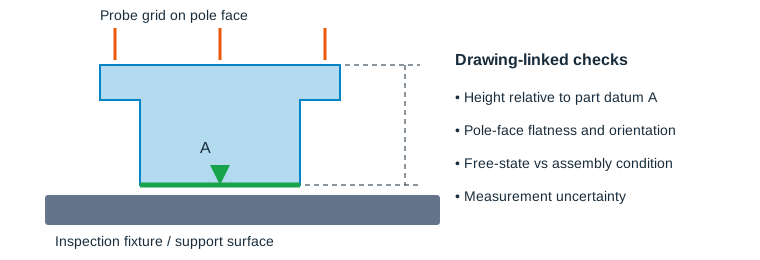
Start from the minimum operating clearance and account for rotor deflection, bearing motion, thermal growth, coating, assembly error and measurement uncertainty. Allocate a tolerance budget to the relevant part and assembly features rather than copying a generic pole-face value.
The controlled drawing must identify the governing GD&T system, datum features, measurement state and agreed inspection method. A granite plate is a fixture surface, not automatically the datum feature of the part. Ask the supplier to demonstrate that the chosen method resolves the stated tolerance.
Basis: editorial procurement guidance. Validate against the project specification; no universal acceptance limit or commercial dataset.
Schematic, not to scale. A part datum feature and the inspection fixture are different; tolerance values come from the controlled drawing. Scroll horizontally on narrow screens.
Editorial procurement worksheet. Unknown commercial and acceptance values require supplier evidence and customer agreement.
| Characteristic | Specify on drawing/plan | Avoid assuming |
|---|---|---|
| Pole-face flatness | Geometric tolerance, state and sampling | TIR is identical to flatness |
| Tooth/assembly height | Datum, assembly condition and uncertainty | One universal height tolerance fits every gap |
| Orientation | Defined datum features and applicable GD&T | Fixture surface automatically defines part datum |
| Surface/edge condition | Finish, radius and insulation interface requirements | Visual smoothness proves magnetic/electrical performance |
Basis: editorial procurement guidance. Validate against the project specification; no universal acceptance limit or commercial dataset.
Recommended procurement action: Approve a drawing-linked inspection plan with engineering and supplier metrology.
8. Match magnetic methods to material and specimen
Measurement standards define methods; the drawing or purchase specification defines acceptance limits.
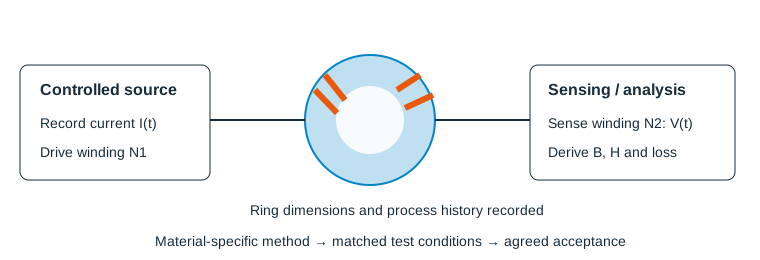
IEC 60404-4 covers DC ring/permeameter methods. IEC 60404-6 covers AC ring testing for its listed metallic and powder materials and excludes electrical steels. For steel sheet/strip, discuss the appropriate electrical-steel method such as IEC 60404-2 with the laboratory. ASTM A772 is an impedance-permeability method, not a generic SMC loss specification.
A companion ring can track a powder lot and thermal process, but it does not reproduce every density gradient, cut edge, winding stress or heat-flow path of the delivered component. Establish correlation to finished parts, and record specimen geometry and process conditions. ISO 3325:2026 is a sintered-metal strength method; applicability to heat-treated non-sintered SMC must be agreed.
Scope references (editorial actions require project validation): IEC 60404-4 — DC magnetic measurement methods · IEC 60404-6:2018 — AC ring measurement methods · IEC 60404-2 — electrical steel sheet/strip measurement · ASTM A772/A772M-00(2022) — AC impedance permeability · ISO 3325:2026 — transverse rupture strength of sintered metals
Conceptual circuit for a suitable ring specimen. The laboratory selects method, excitation, winding and compensation details for the material. Scroll horizontally on narrow screens.
Read left to right; scroll horizontally on narrow screens. This is a procurement workflow, with limits agreed by the responsible engineering team.

Editorial procurement worksheet. Unknown commercial and acceptance values require supplier evidence and customer agreement.
| Measurement | Candidate method | Boundary / acceptance owner |
|---|---|---|
| DC properties | IEC 60404-4 | Use agreed field points and material limits |
| AC powder/covered alloy ring loss | IEC 60404-6 | Excludes electrical steels; agree frequency, B and temperature |
| Electrical steel sheet/strip | IEC 60404-2 | Establish correlation to cut and assembled core |
| Strip impedance permeability | ASTM A772 | Sinusoidal current; not a generic SMC loss test |
| Mechanical TRS | ISO 3325:2026 where applicable | Sintered-metal scope; agree method for non-sintered SMC |
Scope references (editorial actions require project validation): IEC 60404-4 — DC magnetic measurement methods · IEC 60404-6:2018 — AC ring measurement methods · IEC 60404-2 — electrical steel sheet/strip measurement · ASTM A772/A772M-00(2022) — AC impedance permeability · ISO 3325:2026 — transverse rupture strength of sintered metals
Recommended procurement action: Agree a material-specific test matrix and finished-part correlation before lot release.
9. Treat potting as a thermal and mechanical process
Thermal conductivity alone cannot establish retention strength or insulation reliability.
Compare candidate systems using named product data, test temperature, cure schedule, viscosity, bond preparation and ageing conditions. A high filler loading can improve heat conduction while making narrow-gap filling harder. A compliant compound may reduce stress but require a separate structural retention feature.
Define void acceptance by defect location and electrical, thermal or structural consequence. Demonstrate filling and cure on representative assemblies, using sectioning or validated inspection where appropriate. UL insulation-system context can inform material compatibility, but does not set a universal void percentage or resin shear limit.
Scope references (editorial actions require project validation): UL Solutions — electrical insulation systems and UL 1446
Read left to right; scroll horizontally on narrow screens. This is a procurement workflow, with limits agreed by the responsible engineering team.

Editorial procurement worksheet. Unknown commercial and acceptance values require supplier evidence and customer agreement.
| Candidate | Potential benefit | Evidence still required |
|---|---|---|
| Rigid filled resin | Heat flow and bonded support | Product-specific hot/aged bond and thermal stress data |
| Compliant encapsulant | Stress relief and damping | Separate retention path and insulation qualification |
| Molded carrier / mechanical capture | Defined assembly support | Creep, fit, cooling and dielectric validation |
Basis: editorial procurement guidance. Validate against the project specification; no universal acceptance limit or commercial dataset.
Recommended procurement action: Validate the complete material stack and manufacturing route under the intended duty cycle.
10. Validate retention under asymmetric and aged conditions
There is no universal magnetic pull force or proof load per tooth.
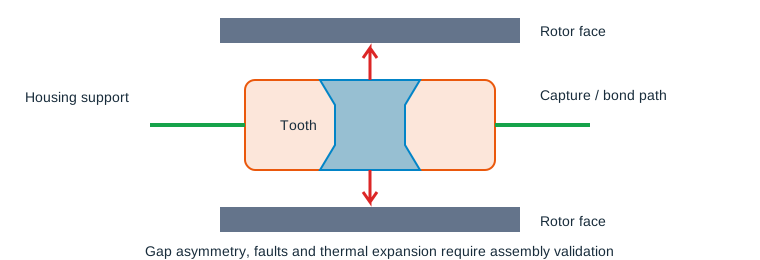
The simple pressure expression B²/(2µ0) assumes an idealized field normal to a surface. Force also needs effective area and field distribution; two air-gap forces do not necessarily produce the same net load. It is unsuitable as a stand-alone fatigue or retention qualification.
Engineering must evaluate gap asymmetry, faults, vibration, thermal expansion and hot/aged bond properties. Select mechanical capture and assembly tests for the actual load path. The approved test plan must define load direction, temperature, conditioning, sample count, failure criterion and justification for proof or fatigue margin.
Basis: editorial procurement guidance. Validate against the project specification; no universal acceptance limit or commercial dataset.
Schematic, not a force calculation. Evaluate attraction on both faces, net imbalance, internal loads and hot/aged support behaviour. Scroll horizontally on narrow screens.
Editorial procurement worksheet. Unknown commercial and acceptance values require supplier evidence and customer agreement.
| Load path | Potential failure | Required validation |
|---|---|---|
| Bonded tooth | Hot/aged debonding or creep | Representative conditioning and load directions |
| Mechanical capture | Contact stress, fatigue or tolerance loss | Structural analysis plus assembly testing |
| Housing/rotor system | Gap asymmetry or thermal deflection | Operating/fault load cases and minimum clearance |
Basis: editorial procurement guidance. Validate against the project specification; no universal acceptance limit or commercial dataset.
Recommended procurement action: Obtain structural analysis and an agreed assembly retention test plan before supplier nomination.
11. Specify converter-fed insulation as a system
DC-bus voltage alone cannot establish PDIV or dielectric withstand test settings.
IEC 60034-18-41 addresses qualification and quality control of Type I winding insulation systems supplied by voltage-source PWM converters. Its scope concerns representative insulation systems or machines, not certification of an unassembled bare core.
Collect motor-terminal waveform data, rise time, cable configuration, temperature and altitude. The responsible electrical engineer must select applicable system tests and distinguish qualification from routine testing. Coating thickness, corner treatment and production limits need validation on the selected stack; no fixed 800 V PDIV or Hi-Pot value is generated here.
Scope references (editorial actions require project validation): IEC 60034-18-41:2014+AMD1:2019 — Type I insulation systems
Conceptual layers, not to scale. Test settings depend on the terminal waveform and complete insulation system; no voltage rating is implied. Scroll horizontally on narrow screens.
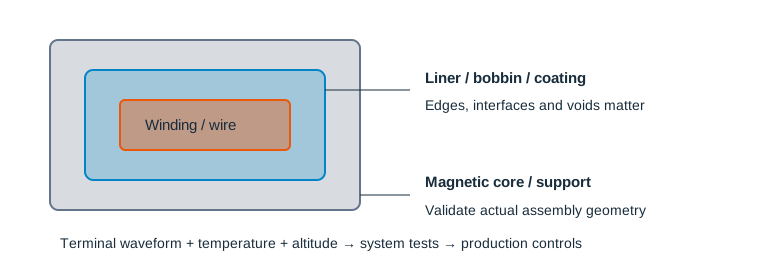
Editorial procurement worksheet. Unknown commercial and acceptance values require supplier evidence and customer agreement.
| Requirement | Required input | Responsible decision |
|---|---|---|
| Converter stress | Terminal waveform, cable, rise time and repetition | Customer electrical engineer / lab |
| System selection | Wire, liner/coating, resin and interfaces | Insulation-system qualification |
| Production control | Agreed routine tests and traceability | Customer-approved control plan |
| Material compatibility | Actual stack and thermal environment | Applicable system evidence; no universal voltage limit |
Scope references (editorial actions require project validation): IEC 60034-18-41:2014+AMD1:2019 — Type I insulation systems · UL Solutions — electrical insulation systems and UL 1446
Recommended procurement action: Agree waveform, insulation class and system/routine test plans with the customer and test laboratory.
12. Prepare a controlled RFQ technical package
Comparable quotations require scope, acceptance, timing and responsibility definitions.
Attach the controlled CAD and drawing revision, individual part mass and quantity per motor set, magnetic targets with test conditions, mechanical/thermal environment and delivery boundary. Identify who owns insulation, winding, potting and assembly validation.
Use the copyable tool brief as an open-items checklist. It does not contain uploaded CAD or validated specifications. Ask each supplier to list exclusions, assumptions, subcontracted operations and the work needed to close each unknown.
Basis: editorial procurement guidance. Validate against the project specification; no universal acceptance limit or commercial dataset.
Editorial procurement worksheet. Unknown commercial and acceptance values require supplier evidence and customer agreement.
| Input | Required detail | Reason |
|---|---|---|
| Geometry | Drawing revision, part mass and quantities per motor set | Comparable scope and tooling review |
| Magnetic target | Grade, B-H/loss and test conditions | Material and process selection |
| Mechanical/thermal duty | Loads, gaps, temperatures, cooling and ageing | Assembly and process validation |
| Electrical scope | Insulation stack and motor-terminal conditions | Appropriate system testing |
| Quality and schedule | Customer package, quantities, milestones and release | Qualification resources and realistic timing |
Basis: editorial procurement guidance. Validate against the project specification; no universal acceptance limit or commercial dataset.
Recommended procurement action: Copy the RFQ checklist, complete its open items and attach controlled files through your agreed inquiry process.
13. Compare landed cost on one quantity basis
A should-cost discussion is useful even when current prices are unknown.
For an accepted motor set, include gross material input, material price, cycle/cavity productivity, thermal processing, secondary operations, yield/scrap, inspection, packaging and delivery. State currency, offer date, validity, quantity basis and treatment of tooling NRE.
Do not double-count tooling by paying it upfront and amortizing it again in every piece. Compare suppliers with and without separately charged qualification and logistics. Cost shares and tooling life are unknown until supported by the supplier process plan and commercial offer.
Basis: editorial procurement guidance. Validate against the project specification; no universal acceptance limit or commercial dataset.
Read left to right; scroll horizontally on narrow screens. This is a procurement workflow, with limits agreed by the responsible engineering team.

Editorial procurement worksheet. Unknown commercial and acceptance values require supplier evidence and customer agreement.
| Cost term | Supplier evidence | Comparison rule |
|---|---|---|
| Material | Gross input mass, grade price and scrap treatment | Same accepted motor-set BOM |
| Conversion | Cycle, cavities, rate and yield | Same process and inspection scope |
| Tooling | NRE, maintenance and amortization terms | Avoid duplicate recovery |
| Qualification | Tests, reports and customer support | Separate one-time and recurring work |
| Delivery | Packaging, freight, duties and delivery terms | Same destination and responsibility split |
Basis: editorial procurement guidance. Validate against the project specification; no universal acceptance limit or commercial dataset.
Recommended procurement action: Request an itemized quotation and compare total cost at the same accepted-set quantity.
14. Qualify a backup instead of assuming interchangeability
A second powder or production site requires technical and customer change approval.
Matching family names or nominal density does not prove equivalence. Compare magnetic curves, mechanical properties, insulation, thermal processing and the delivered assembly response. Establish what tests and approval are required before a substitute can be used.
A backup tool may not fit a second press without adapters or new kinematics. Verify platen/tonnage interfaces, utilities, inspection capability and qualification time. Size buffer stock from actual recovery time and demand variability rather than a universal number of days.
Basis: editorial procurement guidance. Validate against the project specification; no universal acceptance limit or commercial dataset.
Read left to right; scroll horizontally on narrow screens. This is a procurement workflow, with limits agreed by the responsible engineering team.

Editorial procurement worksheet. Unknown commercial and acceptance values require supplier evidence and customer agreement.
| Risk | Mitigation | Evidence before release |
|---|---|---|
| Material interruption | Qualify a second grade | Magnetic, mechanical and assembly equivalence |
| Tool failure | Spares and alternative tooling | Fit and commissioning at the intended press |
| Site outage | Approved backup process/site | Capacity, controls and customer approval |
| Delivery disruption | Recovery-based stock policy | Demand variability and measured replenishment time |
Basis: editorial procurement guidance. Validate against the project specification; no universal acceptance limit or commercial dataset.
Recommended procurement action: Run a documented change/requalification exercise for the backup material, tool and site.
15. Make maintenance and transfer rights explicit
Paid tooling does not by itself define ownership, design access or transfer feasibility.
Agree title, asset identification, permitted use, maintenance responsibility, spares, drawing access and transfer support in the purchase terms. Have the responsible commercial/legal team review the agreement for the relevant contract.
Set inspection and refurbishment intervals from wear trends and resulting part quality. Die-material labels alone cannot guarantee stroke life. Record cavity-specific output and stop criteria, and confirm the time and evidence needed for a new-site approval.
Basis: editorial procurement guidance. Validate against the project specification; no universal acceptance limit or commercial dataset.
Editorial procurement worksheet. Unknown commercial and acceptance values require supplier evidence and customer agreement.
| Asset / activity | Supplier evidence | Term to agree |
|---|---|---|
| Tool identity | Asset ID, cavity and part revisions | Ownership and permitted use |
| Wear control | Shot count linked to dimensional/quality trends | Inspection/refurbishment stop criteria |
| Spares | Replaceable components and drawings | Availability and cost responsibility |
| Transfer | Press interfaces and qualification plan | Access, support and customer change approval |
Basis: editorial procurement guidance. Validate against the project specification; no universal acceptance limit or commercial dataset.
Recommended procurement action: Agree a tool asset register, wear-monitoring plan and practical transfer/requalification procedure.
16. Use evidence gates before weighted scoring
Commercial scoring should follow closure of technical and customer-release gaps.
Before scoring, identify non-negotiable drawing, material, traceability and customer conditions. Mark each supplier response as demonstrated, open or unsupported. Escalate open safety or qualification requirements to the responsible engineering/quality owner.
Agree scorecard weights for the program before reviewing bids. Record the evidence behind each score and keep actions with owners and due dates. A good commercial score does not override a failed requirement or substitute for customer release.
Basis: editorial procurement guidance. Validate against the project specification; no universal acceptance limit or commercial dataset.
Read left to right; scroll horizontally on narrow screens. This is a procurement workflow, with limits agreed by the responsible engineering team.

Editorial procurement worksheet. Unknown commercial and acceptance values require supplier evidence and customer agreement.
| Area | Evidence to inspect | Escalate when |
|---|---|---|
| Material | Grade/lot storage and traceability | Material cannot be traced to delivered parts |
| Manufacturing | Material-specific process controls | Supplier cannot demonstrate reproducibility |
| Thermal processing | Qualified recipe and process records | Actual route differs from validated route |
| Finishing | Dimensional and magnetic checks after finishing | Cut/grind/coating effects are unverified |
| Laboratory | Calibrated methods or qualified external lab | Methods do not match the material or requirements |
Basis: editorial procurement guidance. Validate against the project specification; no universal acceptance limit or commercial dataset.
Recommended procurement action: Hold a cross-functional award review using evidence and open actions, then obtain the required release.
Six Illustrative OEM Sourcing Scenarios
Hypothetical planning exercises, not customer projects or measured procurement outcomes. Volumes are illustrative assumptions; each plan describes evidence required before a sourcing decision.
Hypothetical high-voltage traction program
YASA (Yokeless & Segmented Armature) · SMC (Soft Magnetic Composite) · 15,000 units/yr · Customer requirements to confirm
Sourcing challenge: Oil-cooled segmented teeth; geometry and insulation qualification remain open.
Proposed validation plan: Compare pressing/finishing offers, measure processed-core properties, and validate the complete insulation and retention stack before award.
Hypothetical commercial drive ramp
SSDR (Single Stator Double Rotor) · SMC Segmented Ring Core · 50,000 units/yr · Customer requirements to confirm
Sourcing challenge: Growing demand with uncertain cavity economics and yield.
Proposed validation plan: Request comparable accepted-set quotes at forecast quantities; prove capacity and customer approval before committing production tooling.
Hypothetical aerospace propulsion program
DSSR (Double Stator Single Rotor) · Segmented electrical steel; grade/thickness to confirm · 800 units/yr · Customer requirements to confirm
Sourcing challenge: Traceability and flight-critical qualification evidence are not yet defined.
Proposed validation plan: Agree customer approval, FAI revision and structural/electrical test obligations; QMS certification alone cannot establish airworthiness.
Hypothetical compact robot joint
YASA (Ultra-Thin Axial Length) · High-Permeability SMC · 2,500 units/yr · Customer requirements to confirm
Sourcing challenge: Thin sections may complicate pressing, handling and assembly fits.
Proposed validation plan: Trial representative geometry, inspect ejection damage and correlate loss/strength before selecting the process route.
Hypothetical high-frequency blower
Slotless with magnetic back iron · Fe-Based Amorphous Ribbon · 500 units/yr · Customer requirements to confirm
Sourcing challenge: Slotless design retains magnetic back iron; ribbon performance under assembly stress is unknown.
Proposed validation plan: Compare grade-specific loss at the intended duty points and after encapsulation. If fully coreless, remove the stator core from the RFQ.
Hypothetical marine prototype
SSDR Rim Motor · Encapsulated SMC Potted Teeth · 25 units/yr · Customer requirements to confirm
Sourcing challenge: A low-volume sealed assembly needs corrosion, thermal and retention validation.
Proposed validation plan: Compare feasible prototype routes and compatible encapsulation; obtain a supplier schedule and test plan rather than assuming tool-free manufacture.
Technical & Commercial Sourcing FAQ
Sourcing Strategy & Supplier Selection
Can a radial-motor lamination supplier make AFPM cores?
Possibly. Evaluate the actual axial-core geometry, strip orientation, stacking, finishing and inspection capability. Powder presses are relevant only when the selected route needs powder compaction.
Basis: editorial procurement guidance. Validate against the project specification; no universal acceptance limit or commercial dataset.
What volume justifies a production die?
There is no universal threshold. Compare extra fixed investment against positive unit savings at the same accepted-part basis, including yield, maintenance, requalification and revision risk.
Basis: editorial procurement guidance. Validate against the project specification; no universal acceptance limit or commercial dataset.
How do we distinguish a manufacturer from an intermediary?
Identify which site performs each operation and who controls quality and traceability. Request process records and an audit of critical subcontractors; an intermediary is not automatically incapable.
Basis: editorial procurement guidance. Validate against the project specification; no universal acceptance limit or commercial dataset.
Should we buy bare cores or a full stator?
Compare interface ownership, internal assembly capability, qualification cost and scrap responsibility. The tool adds insulation checks for insulated parts and winding/potting checks for full stators.
Basis: editorial procurement guidance. Validate against the project specification; no universal acceptance limit or commercial dataset.
Does a second region guarantee supply resilience?
No. Verify independent capacity, material availability, tools and customer approval. Shared upstream sources can leave both regions exposed to the same interruption.
Basis: editorial procurement guidance. Validate against the project specification; no universal acceptance limit or commercial dataset.
Tooling, NRE & Prototyping
How long does production tooling take?
Unknown until a dated offer defines design release, tool construction, trials, corrective work, sampling and customer approval. This tool does not publish an unsupported lead-time range.
Basis: editorial procurement guidance. Validate against the project specification; no universal acceptance limit or commercial dataset.
Can prototype SMC parts be machined from blanks?
Ask the supplier to prove blank availability, machinability and post-machining magnetic/mechanical properties for the chosen grade. A generic blank route is not guaranteed for every geometry.
Basis: editorial procurement guidance. Validate against the project specification; no universal acceptance limit or commercial dataset.
Can die material guarantee a fixed stroke life?
No. Wear depends on powder, geometry, lubrication, pressure, clearances and maintenance. Require cavity-level quality trends and agreed refurbishment/stop criteria.
Basis: editorial procurement guidance. Validate against the project specification; no universal acceptance limit or commercial dataset.
Does paying NRE automatically transfer tooling ownership?
Ownership, use, access and relocation rights need explicit contractual terms. Have the responsible commercial/legal team review the agreement; a paid invoice alone is insufficient evidence.
Basis: editorial procurement guidance. Validate against the project specification; no universal acceptance limit or commercial dataset.
How should springback be handled?
Measure it on representative parts and refine the tooling against the approved process. Keep grade, pressure, temperature and metrology conditions traceable rather than using a universal compensation factor.
Basis: editorial procurement guidance. Validate against the project specification; no universal acceptance limit or commercial dataset.
How do we verify finishing has not increased loss?
Compare representative material/parts before and after the qualified finishing route under matched test conditions. Validate any deburring or passivation against the coating system instead of prescribing acid treatment universally.
Scope references (editorial actions require project validation): Höganäs — effect of manufacturing processes on coated SMC
Quality, Testing & Automotive PPAP
Is PPAP Level 3 mandatory for every automotive core?
Confirm the submission level and applicable records with the customer. Level 3 is a planning example here; certification, part submission and production release are separate checks.
Scope references (editorial actions require project validation): AIAG PPAP-4 — Production Part Approval Process
Can a companion ring approve every finished tooth?
It can monitor material/process consistency, but needs correlation to finished-part effects such as density gradients, machining and assembly stress. Agree sampling and acceptance separately.
Basis: editorial procurement guidance. Validate against the project specification; no universal acceptance limit or commercial dataset.
What pole-face flatness should we specify?
Derive it from the assembly clearance budget, deflection, thermal growth and measurement uncertainty. Flatness and runout are distinct, and no universal value is provided by this tool.
Basis: editorial procurement guidance. Validate against the project specification; no universal acceptance limit or commercial dataset.
Which NDT method should screen cracks?
Select a method through representative defect trials and demonstrated detection capability. CT, acoustic or other inspection may be useful, but none guarantees detection of every microcrack in every geometry.
Basis: editorial procurement guidance. Validate against the project specification; no universal acceptance limit or commercial dataset.
Does UL 1446 prove inverter insulation suitability?
System material compatibility and thermal evidence are useful, but must be checked for the actual application. PWM electrical stress needs the appropriate system qualification, not only a generic resin or coating label.
Scope references (editorial actions require project validation): UL Solutions — electrical insulation systems and UL 1446
Does this page calculate VDA 6.3 starred-question downgrades?
No. Use the licensed contracted edition, official interpretations and a competent auditor. The worksheet provides preparation topics without inventing official powder-specific question numbers.
Scope references (editorial actions require project validation): VDA 6.3:2023 — official sanctioned interpretations and FAQs
Does an 800 V bus specify the required PDIV?
No. Terminal waveform, rise time, cable effects, temperature, altitude and insulation-system category matter. The electrical engineer and lab must define qualification and routine tests for the system.
Scope references (editorial actions require project validation): IEC 60034-18-41:2014+AMD1:2019 — Type I insulation systems
Which magnetic method applies to electrical steel?
Discuss an electrical-steel method such as IEC 60404-2 for sheet/strip. IEC 60404-6 excludes electrical steels. Establish an agreed correlation between material specimens and delivered cores.
Scope references (editorial actions require project validation): IEC 60404-2 — electrical steel sheet/strip measurement · IEC 60404-6:2018 — AC ring measurement methods
Commercials, Lead Times & Contracts
What share of unit price is raw material?
Unknown without a supplier cost breakdown. Request mass, yield, conversion, finishing, inspection, tooling recovery and delivery on one accepted motor-set basis.
Basis: editorial procurement guidance. Validate against the project specification; no universal acceptance limit or commercial dataset.
How should material indexation be negotiated?
Agree a relevant index, base date, material share, update interval and verification method. A steel commodity index may not track a processed insulated powder; no universal trigger is assumed.
Basis: editorial procurement guidance. Validate against the project specification; no universal acceptance limit or commercial dataset.
What information makes quotations comparable?
Controlled CAD and drawings, individual part quantities, grade and test conditions, duty envelope, delivery scope, customer approval requirements and a dated volume/ramp schedule.
Basis: editorial procurement guidance. Validate against the project specification; no universal acceptance limit or commercial dataset.
Which NRE payment milestones should we use?
Negotiate measurable milestones such as design review, tool trials, sample acceptance and required customer release. Percentages and payment dates are contract-specific, not set by this page.
Basis: editorial procurement guidance. Validate against the project specification; no universal acceptance limit or commercial dataset.
Can we substitute a nominally equivalent SMC powder?
Only after the agreed material/process/assembly qualification and required customer change approval. Similar family names or a single magnetic measurement do not prove interchangeability.
Basis: editorial procurement guidance. Validate against the project specification; no universal acceptance limit or commercial dataset.
Primary Standards & Evidence Ledger
Scope checked 2026-11-05. Links identify primary publications and manufacturer guidance; public abstracts do not substitute for the licensed standards. Each scope note states its applicability and limits. Customer approval requires the agreed submission and release process, not completion of this checklist.
IATF 16949:2016 — official publications and customer requirements
Automotive QMS reference. Certificate scope and customer-specific requirements must be checked separately; certification does not approve an individual core.
AIAG PPAP-4 — Production Part Approval Process
Production part approval framework. The customer must confirm submission level, applicable records and release conditions; this page is not the licensed manual.
ISO 9001:2026 — quality management systems
QMS requirements. The 2026 edition was published in September 2026; verify certificate edition and transition status with the certification body and customer.
IEC 60404-4 — DC magnetic measurement methods
Ring and permeameter measurement methods for magnetically soft materials. Method scope does not supply a universal part acceptance limit.
IEC 60404-6:2018 — AC ring measurement methods
AC ring testing from 20 Hz to 100 kHz for covered soft metallic and powder materials; explicitly excludes electrical steels and soft ferrites. Confirm amendments and material applicability with the laboratory.
IEC 60404-2 — electrical steel sheet/strip measurement
Epstein-frame methods for electrical steel sheet and strip. Finished cut/stacked core performance still needs a correlated part-level verification plan.
ASTM A772/A772M-00(2022) — AC impedance permeability
Sinusoidal-current impedance permeability for specified strip specimens. It is not a general SMC core-loss acceptance standard.
UL Solutions — electrical insulation systems and UL 1446
System material compatibility and thermal evaluation context. Recognition must be checked for the actual system and application; it does not establish PWM or 800 V suitability by itself.
VDA 6.3:2023 — official sanctioned interpretations and FAQs
Edition-specific process-audit interpretations. Use the licensed manual and competent auditor for scoring and downgrade rules; this page does not assign official question numbers or grades.
IEC 60034-18-41:2014+AMD1:2019 — Type I insulation systems
Qualification and quality-control tests for converter-fed winding insulation systems. A bare core or generic coating is not independently qualified by selecting this reference.
ISO 3325:2026 — transverse rupture strength of sintered metals
Sintered metal TRS method, excluding hardmetals. Application to non-sintered heat-treated SMC needs explicit agreement; retain the exact method/edition reported by the material supplier.
Höganäs Somaloy 5P — manufacturer process guidance
Grade-family processing guidance: 600–800 MPa compaction and N2 heat treatment at a maximum 650°C for 5P. Do not transfer this recipe to every SMC family.
Höganäs — effect of manufacturing processes on coated SMC
Manufacturer study of process-dependent properties, published at WorldPM 2016. Experimental results are material- and process-specific, rather than universal component guarantees.
Submit Your AFPM Core Technical Data Package for Review
Send your 3D CAD STEP file, GD&T drawings, target volume ramp, and magnetic performance envelope. Request a review of material and tooling feasibility, delivery scope and the open qualification requirements. Confirm the review scope and available manufacturing capability before relying on any commercial or technical commitment.
Direct inquiry contact: [email protected]